There are so many treatments available for enlarged pores these days.
From traditional fractional lasers and Pico Fractional Laser treatments to RF microneedling devices like Potenza, the options seem endless. Prices vary significantly, too.
But there's something I've always wondered about pore treatments.
How can we tell whether a treatment is actually working?
Unlike acne, which may visibly improve within days or weeks, enlarged pores can be difficult to evaluate.
Sometimes your skin looks smoother immediately after treatment, but a few weeks later, your pores seem just as noticeable as before.
That's why I think it's important to understand how a treatment works before spending money on multiple sessions.
Today, I want to take a closer look at Pico Fractional Laser treatment, often called Pico Fraxel in Korea.
You may have heard that this treatment helps rebuild the skin from within.
But what does that actually mean?
Let's explore the science behind Pico Fractional Laser, its potential benefits for enlarged pores and acne scars, possible side effects, and how to care for your skin afterward.
1. What Is Pico Fractional Laser Treatment?
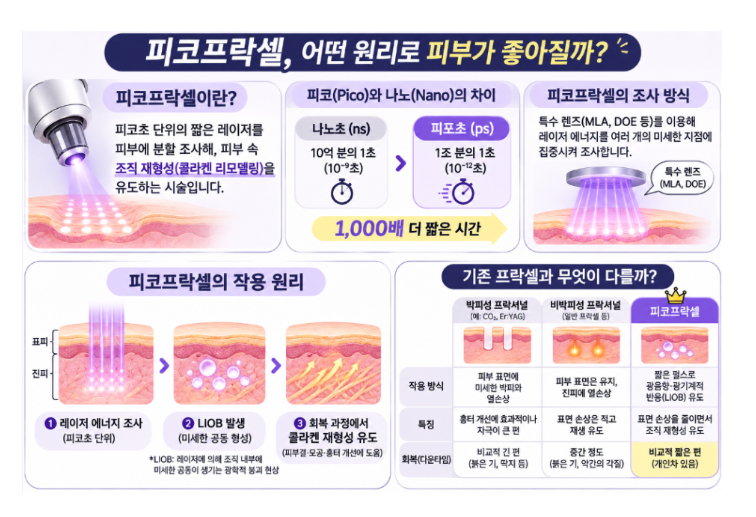
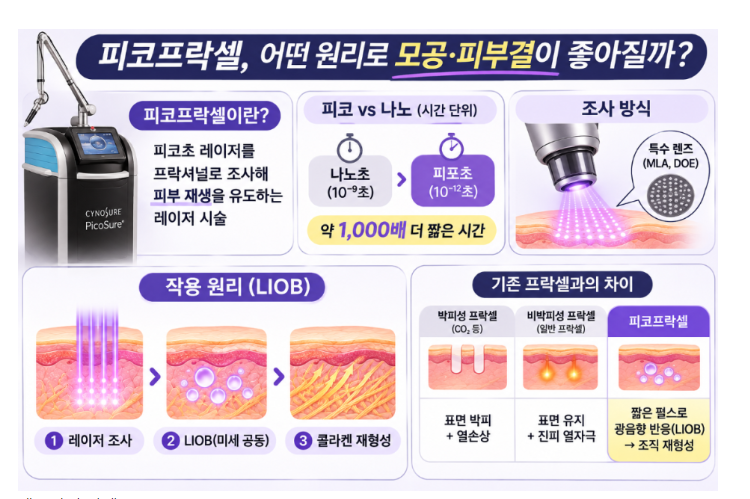
Pico Fractional Laser is a skin treatment that delivers extremely short laser pulses to multiple microscopic areas of the skin.
The word "pico" refers to one trillionth.
A picosecond is one trillionth of a second (10⁻¹² seconds), while a nanosecond is one billionth of a second (10⁻⁹ seconds).
In other words, a picosecond is 1,000 times shorter than a nanosecond.
Picosecond lasers deliver energy in very short pulses, producing photoacoustic and photomechanical effects in the skin.
When specialized optical devices, such as microlens arrays or diffractive optical elements, are used, the laser energy can be concentrated into multiple microscopic treatment zones.
This approach is commonly known as fractional picosecond laser treatment.
However, Pico Fraxel is not the name of one specific laser device.
Different manufacturers use different wavelengths, optical systems, and treatment settings.
This means two clinics offering Pico Fractional Laser treatment may not necessarily be using the same technology.
2. How Does Pico Fractional Laser Work?
One of the important mechanisms associated with certain fractional picosecond lasers is called LIOB.
LIOB stands for Laser-Induced Optical Breakdown.
Although the term sounds complicated, the basic idea is relatively simple.
When laser energy is concentrated into tiny areas of the skin, it can create microscopic cavities within the tissue under specific conditions.
These localized changes trigger a healing response.
As the skin repairs itself, collagen remodeling and other tissue changes may occur.
The process can be summarized in five steps:
- Picosecond laser energy is delivered to microscopic treatment zones.
- Under suitable conditions, laser-induced optical breakdown creates tiny cavities in the tissue.
- Surrounding skin tissue responds to the localized injury.
- Collagen remodeling and tissue repair occur over time.
- These changes may improve skin texture and the appearance of certain acne scars.
This is why some clinics describe the treatment as rebuilding the skin from within.
However, the laser does not literally fill enlarged pores with collagen.
Instead, it may improve the surrounding skin structure, making pores appear less noticeable.
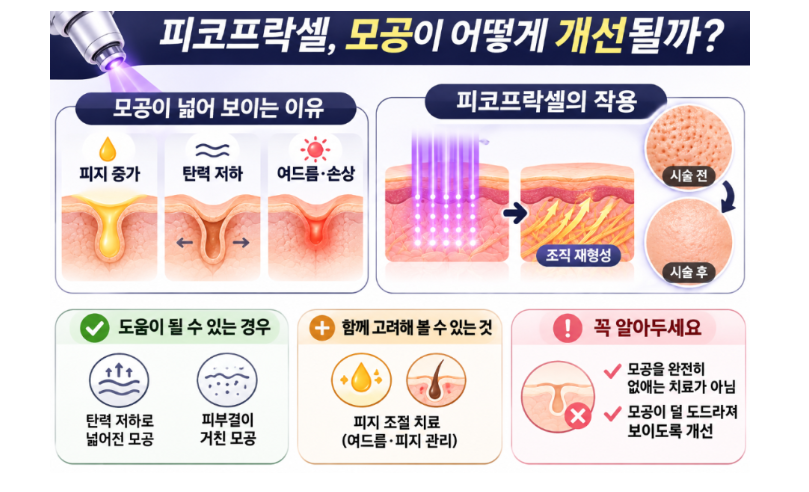
3. Can Pico Fractional Laser Actually Reduce Enlarged Pores?
This is probably the question most people want answered.
Pico Fractional Laser may improve the appearance of enlarged pores by stimulating tissue remodeling around them.
However, it's important to understand why pores become enlarged in the first place.
Pores are normal openings associated with hair follicles and sebaceous glands.
Their appearance can be influenced by several factors:
- Excessive sebum production
- Naturally larger hair follicles
- Reduced skin elasticity
- Aging and collagen changes
- Acne and previous skin damage
Not everyone has enlarged pores for the same reason.
For example, someone with oily skin may have prominent pores primarily because of sebum production.
Another person may notice more visible pores because their skin has gradually lost elasticity.
Pico Fractional Laser may be more helpful when changes in skin texture or surrounding tissue contribute to the appearance of enlarged pores.
However, it does not directly control sebum production.
If excessive oil production is the main problem, additional acne or sebum-management treatments may be necessary.
Another important point is that pores cannot be permanently closed or completely eliminated.
The realistic goal of treatment is to make them less noticeable, not to remove them.
4. Does Pico Fractional Laser Help Acne Scars?
Pico Fractional Laser is also used to treat certain types of atrophic acne scars.
These scars develop when inflammation damages the deeper layers of the skin, leading to collagen loss and uneven tissue repair.
Fractional picosecond laser treatment may stimulate tissue remodeling and improve the appearance of some depressed scars.
Clinical studies have reported improvements in acne scar appearance following treatment with certain picosecond laser systems.
However, not all acne scars respond equally.
There are three common types of atrophic acne scars.
Ice Pick Scars
These are narrow, deep scars that extend into the skin.
Because of their depth, laser treatment alone may not provide sufficient improvement.
Boxcar Scars
These scars have relatively defined edges and a depressed base.
Depending on their depth, fractional laser treatments may help improve their appearance.
Rolling Scars
Rolling scars create broad, wave-like depressions in the skin.
Some are caused by fibrous bands pulling the skin downward.
When significant tethering is present, procedures such as subcision may be necessary.
The important thing is to identify the type of acne scar before choosing a treatment.
Pico Fractional Laser may be helpful, but it cannot guarantee complete scar removal.
5. How Many Pico Fractional Laser Sessions Are Needed?
Another common question is whether one session is enough.
In many cases, multiple sessions are used to achieve gradual improvements in skin texture and acne scars.
Some treatment protocols involve sessions approximately four to six weeks apart.
However, there is no single treatment schedule suitable for everyone.
The number of sessions depends on the device, laser settings, skin condition, and treatment goals.
It's also important to understand that collagen remodeling takes time.
The skin does not produce all of its new collagen immediately after treatment.
This means the final result may not be visible right away.
Temporary swelling can also make the skin look smoother shortly after a procedure.
For that reason, immediate before-and-after comparisons may not accurately reflect long-term results.
6. How Can You Tell Whether Pore Treatment Is Working?
Personally, I think this is one of the most important parts of pore treatment.
You might receive several sessions and feel that your skin looks better.
But how much has it actually improved?
Pores can look different depending on lighting, camera angles, skin hydration, and oil production.
A photograph taken immediately after washing your face may look very different from one taken later in the day.
Here are a few ways to evaluate treatment results more consistently.
Take Photos Under Similar Conditions
Try to use the same lighting, camera distance, and angle.
Avoid comparing photos taken immediately after treatment with photos taken weeks later, since temporary swelling may affect the appearance of pores.
Look at Skin Texture, Not Just Pore Size
Instead of expecting pores to disappear, pay attention to whether the skin surface looks smoother and pores appear less prominent.
Consider Professional Skin Analysis
Some dermatology clinics use imaging systems to evaluate visible pores and skin texture.
These tools may help track changes, although their measurements can also be affected by imaging conditions.
Allow Enough Time
Skin remodeling takes time.
It is generally more useful to evaluate the results at appropriate follow-up appointments rather than judging the treatment immediately afterward.
7. Pico Fractional Laser Side Effects and Recovery Time
Although fractional picosecond lasers may cause less surface damage than some ablative fractional lasers, side effects can still occur.
Redness and Warmth
Temporary redness and a warm or burning sensation may occur after treatment.
These reactions usually improve over time, although their duration varies.
Swelling and Pinpoint Bleeding
Some people develop swelling, small red spots, or purpura.
These reactions may last several days or occasionally longer.
Importantly, pinpoint bleeding does not mean the treatment was more effective.
Likewise, the absence of bleeding does not mean the procedure failed.
Dryness and Peeling
The skin may feel dry, tight, or rough during recovery.
Mild peeling can occur.
Avoid picking or forcibly removing peeling skin.
Acne-Like Breakouts and Folliculitis
Some patients may experience acne-like eruptions or folliculitis after treatment.
Several factors, including skin irritation and skincare products, may contribute.
Post-Inflammatory Hyperpigmentation
One potential complication is post-inflammatory hyperpigmentation, also known as PIH.
This occurs when inflammation triggers excess pigment production, leaving darker patches on the skin.
People who are prone to pigmentation changes may need additional precautions.
Less common complications include blistering, infection, persistent redness, and scarring.
Recovery time varies depending on the device, treatment intensity, and individual skin response.
8. How to Care for Your Skin After Pico Fractional Laser
Proper aftercare is important for reducing irritation and supporting skin recovery.
Keep Your Skin Moisturized
Use a gentle, fragrance-free moisturizer as recommended by your clinician.
You don't need to apply excessive amounts of cream.
More moisturizer does not necessarily mean more collagen production.
Protect Your Skin From the Sun
Sun exposure may worsen irritation and increase the risk of pigmentation changes.
Once your skin is ready and your clinician advises it, use a broad-spectrum sunscreen with SPF 30 or higher.
Hats and shade can provide additional protection.
Avoid Harsh Exfoliation
Temporarily avoid scrubs, strong exfoliating acids, retinoids, and other potentially irritating skincare products.
Follow your clinician's instructions about when to restart them.
Avoid Excessive Heat
Immediately after treatment, it may be helpful to avoid saunas, hot baths, and strenuous exercise that causes excessive sweating.
The recommended duration depends on your treatment settings and skin recovery.
Know When to Contact Your Clinic
Seek medical advice if you experience worsening pain, increasing redness, blisters, pus, significant swelling, or signs of infection.
These symptoms should not automatically be considered part of normal recovery.
9. Pico Fractional Laser vs. Potenza RF Microneedling
If you've researched pore treatments in Korea, you've probably come across Potenza.
Both Pico Fractional Laser and Potenza RF microneedling are used for skin texture and acne scar concerns.
However, they work differently.
Pico Fractional Laser delivers short pulses of laser energy to the skin.
Potenza uses tiny needles to deliver radiofrequency energy into the tissue.
The radiofrequency energy generates controlled thermal injury, which can stimulate collagen remodeling during healing.
Both approaches may help improve skin texture and certain acne scars.
However, one is not automatically better than the other.
The best choice depends on factors such as pore appearance, scar type, skin tone, pigmentation risk, and individual treatment goals.
Combining multiple treatments also does not necessarily produce better results.
10. What Should You Ask Before Getting Pico Fractional Laser?
Before choosing a treatment, I think it's worth asking a few questions.
- Which picosecond laser device will be used?
- Why do my pores appear enlarged?
- Is the treatment primarily targeting pores, acne scars, or skin texture?
- How many sessions are recommended?
- When should I expect to evaluate the results?
- What side effects are possible for my skin type?
- How much recovery time should I plan for?
There are many treatments available for enlarged pores, and new technologies continue to appear.
But choosing the most expensive or most popular device doesn't necessarily mean you'll get the best results.
Understanding why your pores look enlarged and how a treatment is supposed to address that problem is much more useful.
Pico Fractional Laser may improve skin texture, some acne scars, and the appearance of enlarged pores through tissue remodeling.
However, the evidence for acne scar improvement should not automatically be interpreted as proof of equivalent pore-size reduction.
For me, the most important part of any cosmetic procedure is understanding what it can realistically achieve—and how to tell whether it's actually working.
References
- Habbema L, Verhagen R, Van Hal R, Liu Y, Varghese B. Minimally invasive non-thermal laser technology using laser-induced optical breakdown for skin rejuvenation. Journal of Biophotonics. 2012;5(2):194–199.
- Brauer JA, Kazlouskaya V, Alabdulrazzaq H, et al. Use of a picosecond pulse duration laser with specialized optic for treatment of facial acne scarring. JAMA Dermatology. 2015;151(3):278–284. https://pubmed.ncbi.nlm.nih.gov/25409158/
- Manuskiatti W, et al. Efficacy and safety of a 1064-nm picosecond laser with a microlens array for the treatment of atrophic acne scars in Asians. Lasers in Surgery and Medicine. 2021. https://pubmed.ncbi.nlm.nih.gov/33326626/
- American Academy of Dermatology Association. Acne scars: Diagnosis and treatment. https://www.aad.org/public/diseases/acne/derm-treat/scars
- American Academy of Dermatology Association. Acne scars: Self-care. https://www.aad.org/public/diseases/acne/derm-treat/sc
'건강 관련 정보' 카테고리의 다른 글
| 안동병원 종합병원 선택 전 꼭 알아야 할 기준 (0) | 2026.11.15 |
|---|---|
| 엉덩이 주사 안 아프게 맞는 법, 근육주사(IM)가 유독 아픈 이유 5가지 (0) | 2026.11.12 |
| 피코프락셀 모공 효과 있을까? 원리부터 부작용·사후관리까지 (0) | 2026.11.11 |
| 韩国Potenza黄金微针全攻略:毛孔粗大、痘坑、痘印真的能改善吗?效果、价格与恢复期详解 (0) | 2026.11.09 |
| Best Skin Treatments in Korea for Enlarged Pores and Acne Scars: Potenza, RF Microneedling & Lasers (0) | 2026.11.09 |

